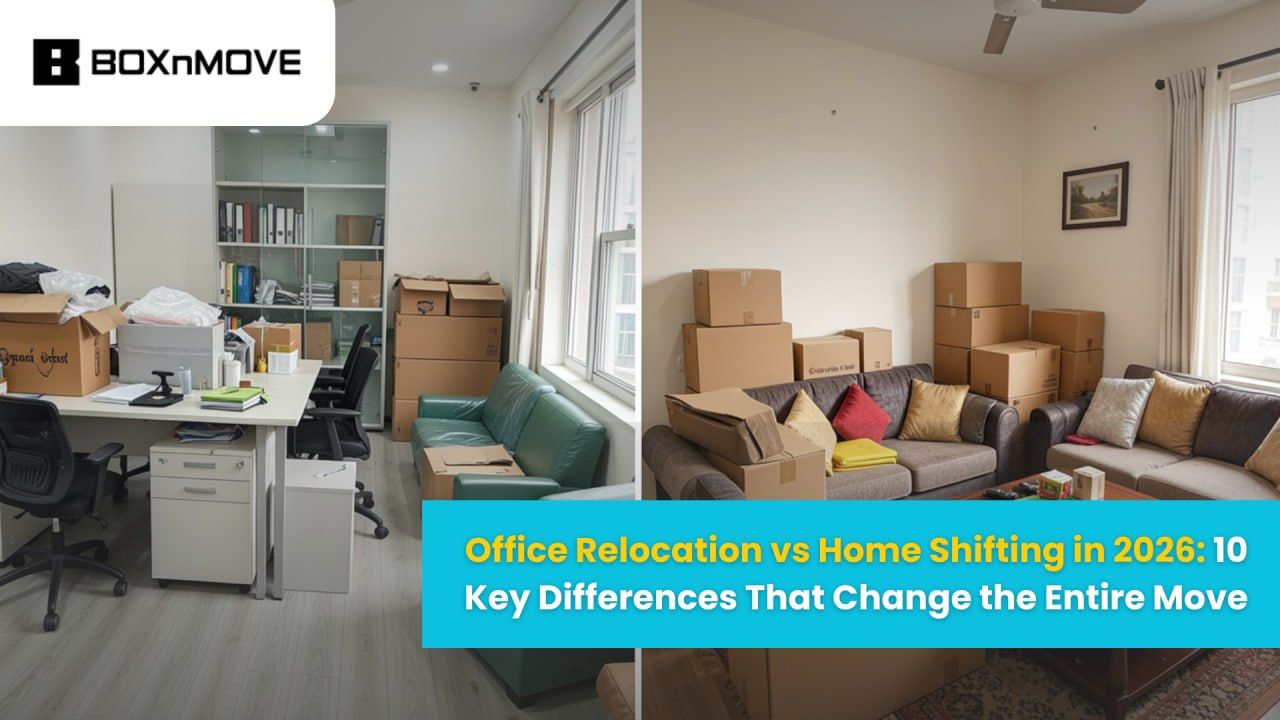
From the outside, relocating an office and shifting a home can look like the same process with a different scale. In both cases, items are packed, loaded, transported, unloaded, and arranged again. But once actual planning starts, the difference becomes very clear. A home move is usually about shifting life with as little stress, confusion, and expense as possible. An office relocation is about shifting operations without damaging continuity, productivity, or coordination. That is why these two moves cannot be planned in the same way, and that is exactly where many people go wrong.
Office Relocation vs Home Shifting - Quick Overview
- A home move is built around comfort, routine, and family needs.
- A business move is built around continuity, systems, and operational readiness.
- Home shifting can tolerate inconvenience for a few days, but office relocation usually cannot tolerate downtime easily.
- Household moving is more personal and emotional, while office moving is more structured and stakeholder-heavy.
- The same mistake, like poor labeling or delayed internet, creates very different consequences in each move.
Difference 1: The Main Goal Of The Move Is Not The Same
A home shift usually begins with a lifestyle reason. It may be a better location, lower rent, more space, ownership, a safer neighborhood, or a better daily routine for the family. So the move is judged by one simple question: how quickly can life feel normal again? An office move begins with a very different kind of reason. A company may need a larger space, a better commercial address, a more practical layout, stronger employee access, or a workplace that fits current operations. So here, the move is judged by another question entirely: how smoothly can the business continue functioning during and after the transition?
That one difference changes everything. A family wants the house to feel livable quickly. A business wants the new location to become workable quickly. One protects comfort. The other protects continuity.
Difference 2: Home Moves Create Disruption, Business Moves Create Downtime Risk
A home shift can absolutely be exhausting. Essential items may be hard to find, the kitchen may not be usable on day one, the internet may take time, and the first night may feel chaotic. But even then, most homes can still function at a basic level while the unpacking continues. Office relocation is much less forgiving because the cost of something not working is more immediate.
If workstations are not ready, if the internet line is not active, if meeting rooms are not functional, if files are misplaced, or if teams cannot sit and start work properly, then the business is not just “settling in slowly.” It is losing productive time. That is why office relocations are planned more carefully around timing, access, sequencing, and readiness. The real risk is not inconvenience. It is an interruption.
Difference 3: The Planning Timeline For An Office Move Is Usually Longer
A household move can sometimes be planned within a few weeks if the destination is confirmed and the family is organized. Office relocation usually needs a much longer runway because more people, systems, and approvals are involved. A business may need to coordinate internal teams, vendors, building management, IT setup, seating plans, internet transfer, access systems, and communication to employees or clients.
That is why office moves are generally phased. There is planning, inventory, vendor coordination, system preparation, move-day execution, and post-move activation. Home moves are also easier when planned early, but they do not usually require the same layered structure. A family may recover from a rushed move with a few tiring days. A company usually pays more visibly for poor planning.
Difference 4: What Is Being Moved Is Very Different
A home move usually involves furniture, appliances, clothing, kitchenware, decor, books, documents, and personal essentials. The value of these items is practical and often emotional. An office move includes desks, chairs, printers, files, devices, routers, server-related equipment, conference-room technology, access systems, department materials, and sometimes confidential records. The value here is not just financial. It is also operational.
A damaged dining chair is annoying. A damaged networking device or misplaced department files can disrupt an entire team. That is why business relocations depend more heavily on item tracking, tagging, asset mapping, and responsibility-based packing. Homes need organization. Offices need organized accountability.
Difference 5: Home Moves Need Family Coordination, Business Moves Need Communication Structure
In a home shift, coordination usually stays within a smaller circle: family members, movers, landlord, society staff, and maybe utility providers. That is still stressful, but it is relatively contained. In a business move, communication expands quickly. Employees need updates, vendors may need new access details, clients may need address communication, internet providers must align on timelines, and internal departments need to know what is happening when.
This is one of the biggest reasons business relocation becomes more complex. Silence creates confusion very fast. If employees do not know seating, timing, access, or readiness plans, the first day becomes messy. If clients or vendors are not informed properly, the relocation starts affecting credibility. A home move needs cooperation. A business move needs communication architecture.
Difference 6: Technology Makes Office Relocation Far More Sensitive
A house move may involve reconnecting Wi-Fi, setting up appliances, and getting a few personal devices working again. An office move is far more technical because daily work often depends on live connectivity, shared systems, devices, and infrastructure. Internet transfer, workstation setup, router placement, cable organization, printer access, access-control systems, and backups all matter.
This is where many people underestimate the gap between commercial and residential moving. In a house, a delayed connection is frustrating. In an office, it can affect meetings, reporting, communication, support, and day-to-day delivery. That is why office relocation must treat IT readiness as part of the move, not as something to “fix later.”
Difference 7: Administrative Updates Are Heavier In Business Relocation
After a home move, people usually need to update their address across banks, subscriptions, insurance, schools, and utility connections. That is important, but still manageable at a personal level. In a business move, address change has a wider reach. Company records, invoices, vendors, bank details, official documentation, website contact information, listings, employee communication, and customer-facing touchpoints may all need updating.
That makes business relocation more administrative than many people realize. It is not only about reaching the new office with boxes. It is also about making sure the business is properly represented and reachable everywhere after the move. A missed home update may delay a bill or delivery. A missed business update may create confusion across multiple stakeholders.
Difference 8: The Budget Structure Is Different
People often assume the main difference is just that office moves cost more. That is true in many cases, but the deeper point is that the budget is built differently. Home shifting budgets usually include movers, packing material, deposits, basic setup, utility transfers, cleaning, and a few first-week purchases. Office relocation budgets may include movers, off-hour labor, IT setup, furniture adjustments, signage, layout-related changes, vendor coordination, and measures taken specifically to reduce downtime.
So a home move is usually judged by whether the expense stayed under control. A business move is judged not only by cost, but also by whether the move protects productivity. In other words, saving money matters in both cases, but in office relocation, protected uptime can matter just as much as direct savings.
Difference 9: Success Looks Different In Both Moves
A home move feels successful when the family is settled, the essentials are accessible, the home is usable, and the first few days are not financially or emotionally overwhelming. An office move feels successful when teams can work, systems are live, assets are traceable, communication is clear, and clients or vendors are not affected in any serious way.
This is why the finish line is different. For a house, “everything arrived” may feel close to success. For a business, that is only the beginning. The real test is whether work resumes smoothly.
Difference 10: The Emotional Pressure Is Different, But Real In Both
Home shifting carries emotional pressure because it disrupts comfort, neighborhood familiarity, children’s routines, sleep, cooking, storage, and the overall rhythm of daily life. Business relocation creates a different type of pressure. Employees may worry about commute changes, seating setup, access, readiness, and whether the shift will affect day-to-day work. Leadership may worry about execution, image, and operational spillover.
So even though one move is personal and the other is professional, both carry stress. The difference is that home stress is usually rooted in routine and belonging, while office stress is rooted in readiness and coordination.
The “What Breaks If This Goes Wrong?” Test
The easiest way to understand the difference between these two moves is to ask one question: what breaks first if something goes wrong?
- If packing is delayed in a home move, the routine gets messy. If packing is delayed in an office move, departments may not be ready on time.
- If the internet is delayed in a home move, it is inconvenient. If the internet is delayed in an office move, work may stop or slow down.
- If labeling is poor in a home move, unpacking becomes frustrating. If labeling is poor in an office move, teams, equipment, and setup order can get confused.
- If address updates are missed in a home move, bills or deliveries may get affected. If address updates are missed in a business move, vendors, clients, records, and visibility may all be impacted.
- If the move runs into overtime at home, fatigue and small extra spending rise. If it runs into overtime for a business, downtime and readiness costs rise.
That is the real difference in one line: a home move breaks comfort first, while a business move breaks continuity first.
Final Thoughts
Relocating a home and relocating a business may both involve boxes, trucks, and schedules, but they are protecting very different things. A home move is protecting comfort, routine, family adjustment, and budget. A business move is protecting continuity, people, systems, and productivity. Once that difference is understood properly, the planning approach becomes much clearer, and that is also why BoxnMove fits better when the move is handled with process instead of guesswork.
FAQs
1. What is the biggest difference between office relocation and home shifting?
The biggest difference is the purpose. Home shifting is mainly about restoring daily life, while office relocation is mainly about maintaining business continuity.
2. Why is business relocation considered more complex?
Because it usually involves employees, systems, communication, assets, vendors, connectivity, and operational readiness, not just physical movement.
3. Is home shifting easier than office relocation?
Usually yes, but not always simple. Home shifting is less operationally complex, though it can still be stressful and expensive if poorly planned.
4. Why does internet setup matter more in office relocation?
Because a delayed internet connection in an office can slow or stop team productivity, meetings, communication, and workflow.
5. How should someone plan a home move differently from an office move?
A home move should focus more on essentials, routine restoration, and budget control. An office move should focus more on sequencing, communication, system readiness, and continuity.