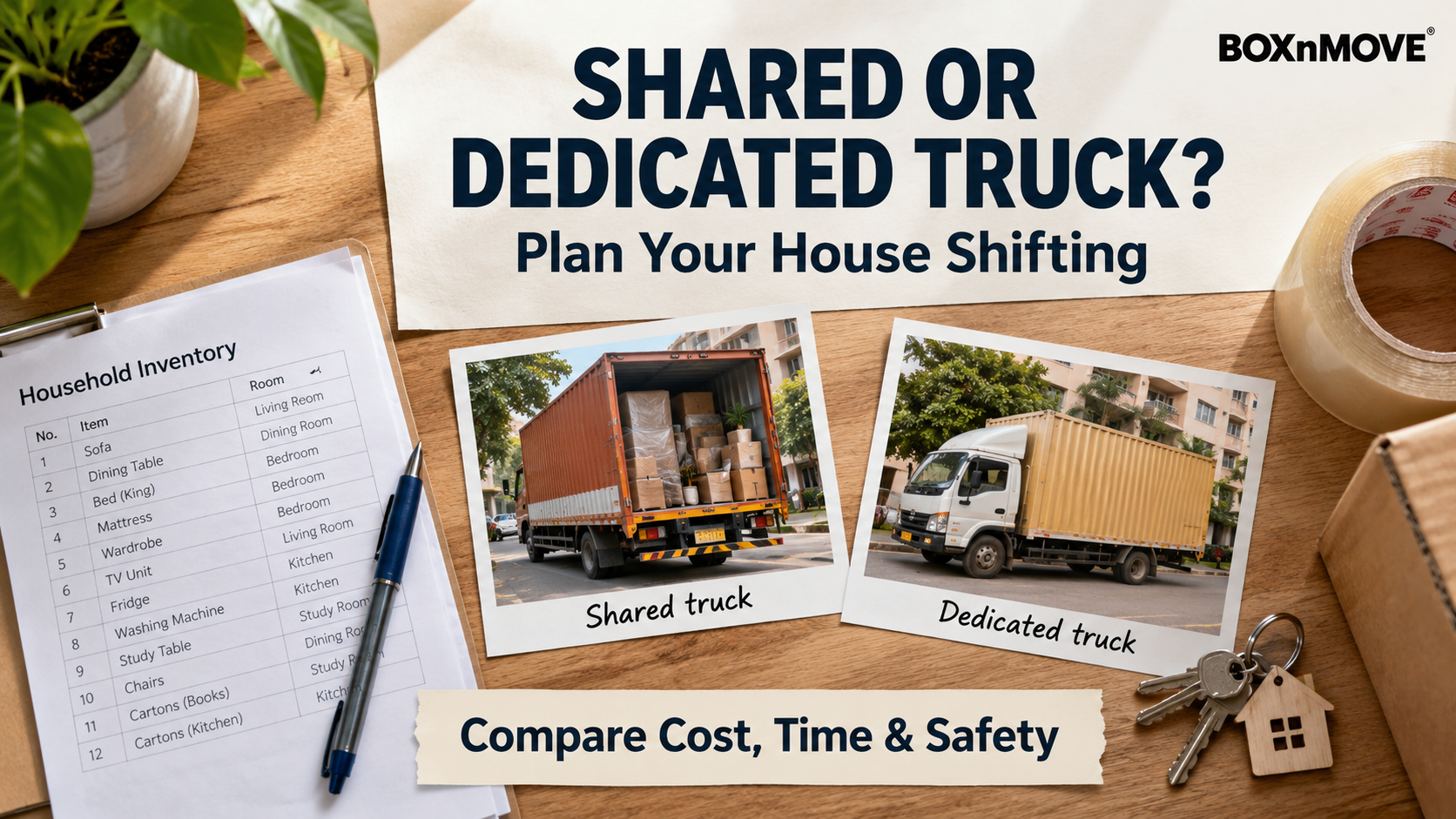
If you have ever stood in the middle of half‑packed cartons and thought, “Should I just book a truck and do this myself instead of paying packers so much money?”, you are not alone. Almost every family in India hits this question at some point. At first glance the choice looks simple: either hire full‑service packers and movers, or rent a vehicle, call a few helpers and shift on your own.
But once you look a little deeper, you realise this is not only about who is cheaper. It is also about how much time you can spare, how much physical work you can realistically do, how much risk you are comfortable carrying on your own head, and what kind of move you are actually planning - a light PG move inside the same locality, or a full 2BHK going from one city to another.
In this guide, we will unpack all of that slowly and clearly. You will see what full‑service shifting companies actually do, what a real self‑move involves in India, how the costs really behave, what the moving day feels like under each option, and how to choose the path that is genuinely right for your move instead of blindly following what friends or relatives did.
What Full‑Service Relocation Service Providers And Self Move Really Mean In India
Before you compare, you need to know what exactly is being compared. Many people say packers and movers on one side and “self move” on the other, but in reality there are multiple shades inside both.
What is a Full-Service Relocation Service?
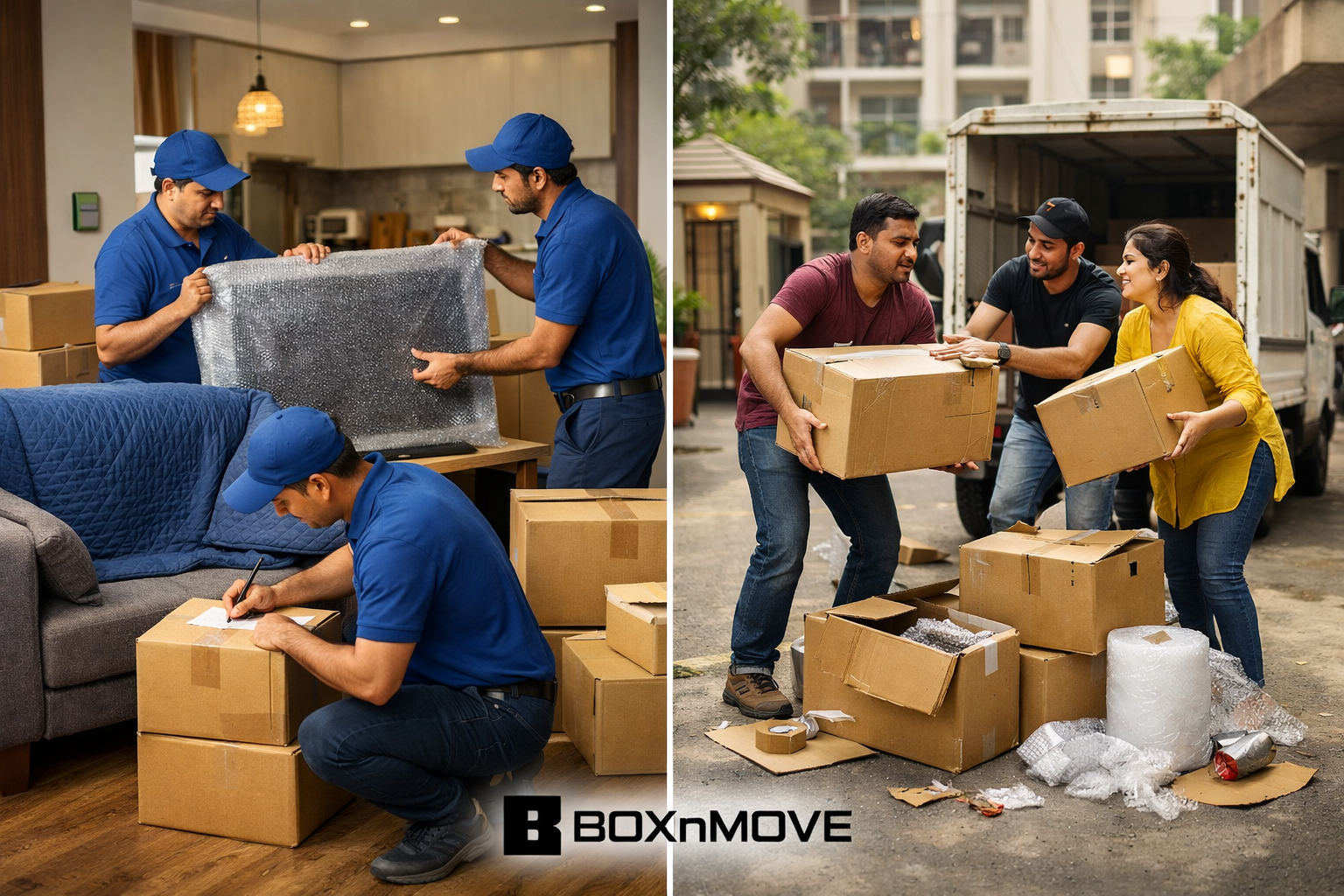
When people talk about full‑service packers and movers, they usually mean a team that comes home with packing material, packs your belongings, dismantles basic furniture where needed, labels boxes, loads everything into a truck, transports it to the new address, unloads it there and sets up the main items again. In a lot of Indian cities, this also includes navigating society rules, dealing with guards, booking lifts, managing floor‑based charges, arranging long‑carry from gate to flat, and handling local quirks like narrow lanes or no‑parking zones.
A truly full‑service experience means you are not worrying about buying cartons or bubble wrap, you are not the one lifting sofas down the stairs, and you are not juggling between driver, loaders and building security. You are still involved - you have to guide what goes where and keep an eye on valuables - but the heavy, repetitive work is handled by people who do this every day.
What is a Self Move?
On the other side sits the umbrella term self move or DIY moving. In most Indian cases, this means you are responsible for everything. You arrange or buy packing material, you pack every room, you label boxes, you find and book a truck or tempo, you coordinate timings with the driver, you either lift things yourself or hire separate casual labour, you supervise loading and unloading, and then you also manage the entire set‑up in the new place.
Even within DIY, there are variations. Some people go fully self‑driven, renting a small truck or pickup and driving it themselves. Others hire only a vehicle with a driver and bring friends or family for lifting help. Some hire two or three loaders separately by the hour but still handle packing and planning themselves. All of these fall under the broad bracket of self move because the responsibility and coordination sit with you, not with a single accountable moving company.
Once you see these definitions clearly, it becomes easier to understand why two families with very different setups, strengths and house sizes may reach very different decisions about which option is better.
Cost Comparison: Is DIY Really Cheaper Once You Add Everything?
Most people start with one thought: “Packers and movers quoted too much, DIY will be much cheaper.” Sometimes this is true. Many times, it is not that simple.
With full‑service shifting companies, the quote you receive usually bundles many separate expenses into one number. You are paying for packing materials like cartons, tape, wrap and blankets; for the time and labour of a trained crew; for the truck, fuel and driver; and often for some level of basic risk cover or liability. The number feels heavy because you see it as one lump sum. What you do not see are the individual micro‑costs you would have had to plan and pay for on your own.
With a self move, your first visible cost is the truck or tempo rental. There will usually be a base rate that includes a certain number of kilometres and hours, and then extra charges if you go beyond either. On top of that, you have to buy or arrange packing material, which adds up faster than people expect when you start buying good cartons, bubble wrap, stretch film and decent tape. If you cannot do the lifting yourself, you pay loaders separately. For intercity moves, fuel, tolls and driver allowances sit on your side of the table. And that is before we talk about hidden costs like leave from work, damage to goods or small fines for accidentally denting a lift or wall.
When you are comparing costs honestly, it helps to write down both sides in detail. On the full‑service side, note the all‑inclusive quote and any add‑ons. On the DIY side, list truck rental, fuel and tolls, packing materials, loader charges, potential parking or entry fees, at least one day of your time (or more for a 2BHK+), and a realistic buffer for minor breakage or repairs. Once you do this exercise on paper, the gap between “expensive packers” and “cheap DIY” often becomes much narrower than the initial feeling in your head.
Where DIY can genuinely win is in very small moves. If you are a student or a single working professional with a few suitcases, a chair, a small shelf and maybe a monitor or TV, hiring full‑service packers and movers may not make sense. Shifting within the same locality or even the same building with the help of friends and a small rented vehicle can be affordable and perfectly fine. The same applies for partial moves where you are only relocating a few items, not an entire household.
But once you cross into full‑house territory - a 1BHK packed to the brim, a 2BHK or 3BHK, or an independent house with furniture and appliances - the math tends to tilt towards professional packers providing better value per unit of effort and risk, even if the sticker price is higher.
Time, Effort And Stress: How Moving Day Actually Feels In Both Options
Money is one part of the story. The other part, which people often underestimate, is how your body and mind will feel during the move.
Imagine you choose a self move for a typical 2BHK. The night before the move, you are probably still packing. You come home after work, eat something quickly and then stand in the living room trying to decide what to put into which carton. At some point you realise you have run out of boxes or tape and either rush to buy more or start compromising - mixing kitchen items with books, clothes with electronics - just to get it done. By midnight, you are tired and irritated, but there is still a balcony, a part of the kitchen or a cupboard left.
On moving day morning, the truck is scheduled for a specific time. You are managing calls from the driver, answering questions from the society guard about entry and parking, and at the same time trying to quickly seal last‑minute boxes. If you are relying on friends, they may be late or stuck in traffic. If you have called loaders, you are trying to negotiate where they will wait and how long they will stay.
As loading starts, every box and piece of furniture becomes your problem. You are the one deciding which box goes first, how to angle the wardrobe through the door, and what to do with items that don’t fit the way you imagined. If there are stairs or a long distance from gate to flat, the work feels endless. By the time everything is in the truck, you are sweaty, anxious about fragile items and already half exhausted.
At the new place, the cycle repeats in reverse. You now have to make sure nothing gets left behind in the truck, direct every box into the correct room, check for visible damage and somehow find enough energy to set up at least the bed and basic kitchen. It is common to end the day with a sore back, strained muscles and a house that looks like a warehouse.
Contrast this with a day where you hire full‑service packers. The night before, you still have to do some work - separating important documents, packing a personal essentials bag, deciding what not to send in the truck. But you do not have to play Tetris with cartons or hunt desperately for more tape. When the team arrives, they unpack their own materials and start working in a pattern. One person disassembles furniture, another handles kitchen packing, another works on books and clothes. Boxes are labelled by room and type. You walk through, answer questions and point out what is fragile or high‑priority, but you are not the one lifting and loading.
Of course, you will still feel tired by the end of the day. Moving is inherently disruptive. But there is a big difference between the tiredness that comes from supervising a well‑run process and the tiredness that comes from being the project manager, main labourer and problem‑solver all at once. When you think about your next move, do not just ask, “Can I save money?” Ask also, “In what state do I want to reach my new home?”
Risk, Safety And Responsibility: Who Carries The Burden When Things Go Wrong?
Another important axis in this decision is risk. When people choose DIY, they are not just taking on more work; they are also taking on more responsibility.
In a self move, if a heavy box slips and lands badly on your foot or back, there is no company health cover or safety protocol; it is your injury to deal with. If a wardrobe bangs into the lift door and leaves a dent, the society may ask you to pay for repairs. If your TV falls while being carried by an inexperienced helper, you pay for the replacement. Even small incidents like dropping a glass table or scratching a polished floor can quickly turn into stressful, expensive conversations.
Professional service providers are not magic; accidents can happen with them too. The difference is that a good company will have trained crews, better techniques, better equipment and some form of risk management. They know how to angle large furniture through tight spaces, how to use blankets and pads to protect both items and property, and how to stack a truck so that heavier items support and do not crush lighter ones.
There is also the question of goods in transit. In most DIY scenarios, your items are travelling at your risk. The driver’s vehicle insurance typically covers the vehicle, not what is inside it. If there is an accident or weather damage, there may be no straightforward claim path for you. With professional shifting companies, there is usually at least a basic level of liability for negligence and often an option to take separate transit insurance for high‑value loads. That does not guarantee that every single incident will be resolved perfectly, but it gives you a framework that does not exist when you are moving purely on your own.
Risk is also about emotional safety. In the days leading up to a move and in the days after, you still have office deliverables, family routines, school schedules, health issues and a hundred other things to manage. If you choose a path where you carry all physical and financial risk on your own shoulders, you have to be honest about whether you truly have the bandwidth to hold that calmly.
Control, Convenience And What Kind Of Mover You Really Are
Not every decision in life has to be purely rational. Some people prefer to drive their own car rather than sit in the back seat, even when a driver is available. Moving has a similar personality element.
Many people prefer a self move because it gives them a sense of complete control. They pack items in their own style, they know exactly which box holds what, and they do not have to share their personal environment with strangers for long hours. For highly privacy‑conscious individuals or for very small moves where the load is light and the time flexibility is high, this preference for control can make DIY genuinely feel better, not just cheaper.
Others want something very different. For them, the biggest concern is not control but convenience and predictability. They may be working long hours, caring for small children or elderly parents, or dealing with their own health limitations. For them, the idea of lifting heavy things, climbing stairs repeatedly or spending nights packing after office hours is simply not realistic. They would rather pay more and let professionals carry the bulk of the workload so that they can focus on keeping their family calm and their work stable.
Neither type of person is right or wrong. The problem only appears when someone whose life is already overloaded chooses DIY because they only looked at the price and did not factor in the value of their limited energy and attention.
Packers & Movers vs Self Move in India - Overview
| Factor | Full-Service Packers & Movers | Self Move (DIY) |
|---|---|---|
| Who handles packing? | Professional team brings materials and packs everything systematically | You arrange materials and pack all items yourself |
| Loading & unloading | Done by trained movers using proper techniques | You, friends, or hired casual labour handle lifting |
| Furniture handling | Furniture is dismantled, padded, moved and reassembled | You manage dismantling, lifting, fitting and alignment |
| Truck & transport | Included in one coordinated service | You book the truck/tempo and manage timing and routes |
| Coordination effort | Single point of responsibility | You coordinate driver, helpers, society and timing |
| Time required | Faster and more predictable | Takes longer, often spills over multiple days |
| Physical effort | Minimal physical strain | High physical effort and fatigue |
| Risk of damage | Lower due to experience, packing quality and equipment | Higher due to inexperience and rushed packing |
| Insurance / liability | Basic liability + optional transit insurance | Usually no coverage for goods in transit |
| Cost structure | Higher upfront, bundled and predictable | Looks cheaper initially but adds up with hidden costs |
| Hidden costs | Few (mostly transparent add-ons) | Packing material, extra hours, damage, leave from work |
| Stress level | Relatively low | High, especially for full-house moves |
| Best suited for | 1BHK+, intercity moves, families, tight timelines | PG, hostel, light 1RK, short local moves |
| Control over packing | Moderate (you supervise) | Full control |
| Overall convenience | High | Low to moderate |
A Simple Decision Scorecard: DIY, Full‑Service Or Something In Between?
If you still feel stuck, it may help to treat this like a small self‑assessment instead of a yes/no question.
DIY or a light self move can work well if most of the following statements feel true for you: your move is within the same city and not extremely far across town, your total belongings are closer to a 1RK or light 1BHK than a fully loaded 3BHK, you do not own many large fragile or expensive items, you have a few healthy friends or family members who are genuinely available to help, you are comfortable planning logistics and dealing with truck vendors, and your move‑out date is flexible enough that delays will not create a crisis.
Full‑service packers and movers usually make more sense when your situation is the opposite. You are shifting a full 1BHK or larger, you own major appliances and heavy furniture, you are moving to another part of the city or another city altogether, your housing societies have strict timing rules or difficult access, you have young children, seniors or pets to care for, your own health is not in a place where you can do intense physical work safely, and you have a specific handover or possession date that you cannot miss.
If your answers are mixed - for example, you have a 2BHK but very few fragile items, or you are moving locally but have a bad back - consider a hybrid approach. That could mean packing all clothes, books and light items yourself and only hiring professionals for furniture, appliances and transport. Or it could mean hiring a smaller full‑service crew for key rooms like the kitchen and living room while handling less sensitive areas on your own.
The point of this scorecard is not to force a label on you. It is to make sure you are honest about your reality instead of deciding based only on one factor like cost or what a friend did three years ago.
Final Thoughts: Choose The Option That Protects Both Your Belongings And Your Bandwidth
At the end of the day, moving is not an exam where there is one correct answer and every other choice is wrong. It is a trade‑off. On one side, you have money; on the other side, you have time, energy, risk and peace of mind. Full‑service packers and movers push more of the work, risk and responsibility onto trained teams and systems. Self moves keep more control and sometimes save money, but they also push more load and exposure back onto you.
If you are a student shifting across the street with two bags and a suitcase, it would almost be wasteful to call a full crew. If you are a working couple with two children, a full 2BHK, a large TV, multiple appliances and a deadline from your landlord, forcing yourself into a pure DIY move just to save some money can easily turn into regret. The right choice is the one where you can look at your calendar, your body, your bank balance and your belongings and feel that the balance is fair.
From our side, when we look at moves, we have seen enough stories to know that no two families are exactly alike. That is why, when we at BOXnMOVE talk to someone about shifting, we do not assume that full‑service is automatically the answer. We try to understand what they are moving, where they are in life right now, how much time they realistically have and what they are most afraid of - damage, delays or burnout. Only then do we suggest whether they truly need a complete pack‑and‑move, a more focused service or even a phased plan that lets them breathe. If this blog has helped you see your own situation more clearly, then you are already much closer to choosing the kind of move that will not just get your things from Point A to Point B, but will also let you arrive in your new home with your body, mind and belongings intact.
FAQs on Packers & Movers vs Self Move in India
Q1. Is it always cheaper to do a self move instead of hiring packers and movers?
Not always. DIY looks cheaper at first, but once you add truck/tempo charges, fuel, packing material, loaders, leave from work and possible damage, the gap often becomes much smaller for a 1BHK+ move.
Q2. When does a self move actually make sense?
Self moving works best for very small loads like a hostel room or light 1RK, short-distance moves, and when you have enough time, helpers and no major appliances or heavy furniture to handle.
Q3. For what kind of moves are full-service packers and movers usually better?
Full-service packers are usually the safer choice for 1BHK+ houses, intercity moves, homes with large appliances and heavy furniture, senior citizens or families with kids, and when you are bound by strict move-out or possession dates.
Q4. What hidden costs do people forget when planning a DIY move?
They often ignore the cost of quality packing materials, extra truck hours, fuel and tolls, separate loader charges, minor damage repairs, society or lift penalties and the value of their own time and lost workdays.
Q5. Who is responsible if something breaks during a self move?
In a self move, you carry almost all the responsibility. The driver’s vehicle insurance typically covers only the vehicle, not your belongings, so damage to goods usually has to be absorbed by you.
Q6. Do packers and movers provide insurance for my goods?
Most organised relocation service providers offer basic liability and an option for separate transit insurance, especially for intercity moves. It’s important to ask what is covered, what is excluded and how the claim process works before moving.
Q7. I’m very privacy-conscious. Can I still hire full-service packers?
Yes. You can pre-pack extremely personal items yourself and let the packers handle bulky furniture, appliances and general cartons. Clear instructions, supervision and keeping valuables with you usually solve most privacy worries.
Also Read
- Best Packers and Movers App
- Common Packing Mistakes while Moving
- Auspicious Days to Buy a Home in 2026
- Best Times of Year to Move in India
- Griha Pravesh Muhurat 2026