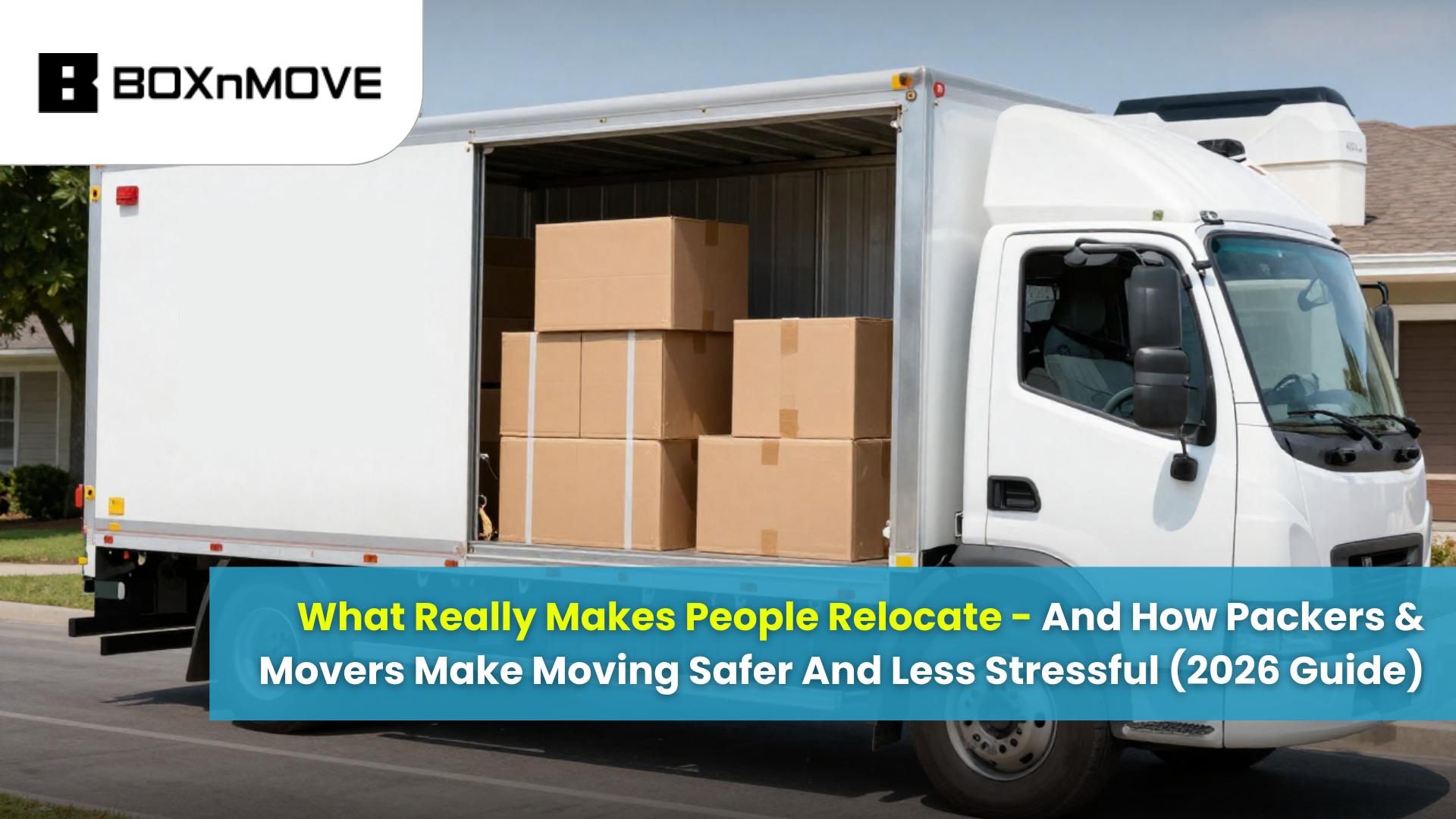
When you look at a move from the outside, it always seems simple. A few people were packing, some cartons stacked in the living room, a truck parked downstairs and a new address at the other end. But anyone who has actually relocated knows that it is never just about the boxes or the transport. Behind every move there is a bigger story: a new job, a child’s education, a marriage, a health issue, parents getting older, rent becoming impossible, or a long-held dream of owning a home finally coming true.
Most people only search for packers and movers near me when the decision is almost final. Inside their mind the real question is not “which shifting company is cheapest” but “will this move actually make life better or will it become one more stressful thing that drains us for months?”. That is where the difference between understanding why you are relocating and how you choose to move becomes very important.
In this guide, we will go in detail into what actually causes people to relocate today, especially in Indian cities, and then we will connect that to the way professional packers and movers can make the process safer, calmer and more predictable. The goal is not to sell you on moving companies for the sake of it, but to help you see clearly where expert help genuinely protects your time, your belongings and the real reason you decided to shift in the first place.
Moving Is Never Just Moving: Why Does This Question Matters?
If you talk to ten different families who recently shifted, every story sounds different on the surface. One shifted from Gurgaon to Bangalore for a promotion. One moved from an older colony in Delhi to a gated society in Noida for safety and amenities. One couple downsized after the children moved out. Someone else relocated after marriage to live closer to in-laws. On paper these are different moves, but emotionally they all start from the same place: something in the current life stopped feeling right, or something in the future started pulling strongly enough that staying became harder than leaving.
That is why treating relocation as a purely logistical task always feels slightly wrong to the people inside it. When you only look at the move as “2BHK, so many cartons, so many kilometres”, you miss the part where a child is leaving their school friends, a parent is leaving a neighbourhood they know by heart, or a working professional is taking a calculated risk to move to a new city and role. The more honest you are about your real reason to move, the easier it becomes to choose the right timing, the right kind of help and the right level of planning.
Packers and movers enter this picture not as magicians, but as people who take over one complete layer of stress so that you can focus on the bigger decision and the people involved in it. To understand how much that layer matters, it helps to first look at the main reasons people relocate today.
The Big Reasons People Relocate Today
People do not uproot their lives for fun. There are a few big clusters of reasons that keep showing up again and again in real stories, surveys and migration data. Once you see these clearly, you can almost always place your own move somewhere inside this map.
1. Career And Work: Better Jobs, Transfers And Business Moves
For many working professionals, the biggest driver of relocation is career. You get a job offer in another city that pays better or gives you a more meaningful role. Your company opens a new office in a different metro and asks you to move as part of a promotion or leadership track. You are a founder who realises that your customers, investors or team are mostly concentrated in one region, so moving closer to that hub makes business sense.
Even within the same city, work pushes people to shift. Daily commutes of two hours each way slowly wear people down, and after a point, living closer to the workplace feels like a necessity rather than a luxury. Young professionals move from PG or roommate setups into more stable rental flats when their income improves. Remote roles sometimes turn into hybrid or office-first models, forcing people to adjust their location again.
Underneath all this is one simple reality: if your work life improves significantly with relocation, you are more willing to accept short-term pain in exchange for long-term growth. But exactly because your work is so central, you cannot afford for the move to derail your joining date, your early performance or your ability to focus in those crucial first weeks.
2. Family, Marriage And Support Systems
The second big cluster is family. In India, relocation after marriage is still one of the most common moves, especially for women, but increasingly couples take joint decisions to move closer to where support systems are stronger for both sides. A couple might leave a metro to return to a tier-two city where their parents live. New parents might shift into a locality where grandparents can help with childcare. Sometimes families move so that siblings can live in the same city again.
Family relocation can also be triggered by stress. When parents’ health starts to decline, children may move back to their hometown or bring parents into the city. When there is friction in a joint family setup, a couple might move out into a separate flat. These moves are not only about square feet; they are about emotional distance, daily interactions and who is physically available when things go wrong.
Because there is so much emotion inside family moves, the actual logistics often get pushed to the background until the last moment. People put their energy into conversations, rituals, school admission forms, medical appointments and travel plans, and suddenly realise that packing, loading and moving the entire house still remains as a huge block of work.
3. Housing, Lifestyle And Cost Of Living
Another very common set of reasons is about the home itself. A growing family needs one more room. Children are entering crucial school years and parents want a quieter, safer neighbourhood. People who have spent years in older, congested colonies decide to move to apartments with lifts, security, parking and basic amenities. Others do the opposite: they move out from high-rise towers into independent floors or plotted developments for more control and space.
Money is often a parallel driver here. When rents rise faster than incomes, families look for similar homes in slightly farther sectors or different parts of the city. People under heavy EMI pressure may choose to downsize and breathe financially. Some relocate to cities or localities where they can finally afford to buy instead of rent, even if it means being away from the original metro.
Lifestyle shifts also push relocation. If your current area has constant traffic, noise and pollution, you may be willing to accept a longer commute in exchange for cleaner surroundings and better air. If your children’s hobbies or your own work demand certain amenities nearby, you may hunt for a house closer to those facilities.
4. Education, Health And Life-Stage Changes
Education and health are quieter but powerful reasons to move. Students shift cities for college, coaching or specialised courses. Families move closer to reputed schools or universities. Parents whose children have long commutes to school might relocate closer to reduce daily strain.
Health-related relocation tends to happen after a shock. A serious diagnosis might require frequent hospital visits, making proximity to a particular hospital or medical hub critical. People who struggle with respiratory issues might move away from highly polluted pockets to slightly cleaner areas or hill towns. As parents or individuals age, staying near reliable healthcare sometimes becomes more important than being near the most glamorous neighbourhoods.
Life-stage changes like retirement also bring relocation decisions. Some people return to their hometowns after decades in metros. Others move from big houses into more manageable apartments. In all these cases, energy levels are lower and tolerance for chaos is limited, which makes the way you handle the move even more important.
5. Unexpected Triggers: Disasters, Water Problems And Redevelopment
Not every relocation is planned months in advance. Sometimes the push comes suddenly. Floods, building leaks, structural cracks, water scarcity, fire incidents or notice of redevelopment can force families to move even when they are not emotionally ready. In these cases, relocation is less about ambition and more about safety and survival.
People affected by such events often have to find temporary housing first and then think about long-term options. They may need to move their belongings into storage, spread family members across different homes, and keep documents and valuables extra safe. The emotional state here is very different from a celebratory move into a dream home, but the amount of work required can be even higher.
Push vs Pull: How The Same Move Can Feel Completely Different
One helpful way to think about relocation is to separate push and pull. Push factors are the things that make it hard to stay where you are: high rent, unsafe neighbourhoods, water problems, landlord issues, lack of career opportunities, daily exhaustion from commuting, or tension in shared homes. Pull factors are the things that attract you elsewhere: a better job, a bigger or more comfortable home, better schools, closer family, cleaner surroundings or simply a place that feels more “you”.
The same move can be experienced as mostly push or mostly pull depending on your situation. Imagine someone moving because their landlord suddenly hiked the rent and refused to negotiate. They might feel cornered and stressed, even if the new house is objectively better. Now imagine a family moving from a cramped 1BHK to their first owned 2BHK after years of saving. The work of moving is the same, but in their minds the move is attached to pride and relief.
Why does this matter for packing and moving? Because your emotional starting point changes what kind of help you need. If you are already under strong push pressure, you have less patience and less buffer for things going wrong during the move. If you are moving for a dream, you still want things to go smoothly, but you may carry more energy and forgiveness for small glitches. Understanding whether you are moving away from something or towards something helps you decide how much professional support you should lean on instead of trying to carry everything on your own shoulders.
Why Moving Is So Stressful (Even When The Reason Is Positive)
People underestimate how heavy moving feels until they are deep inside it. Even when the reason is positive, the process can be overwhelming. Part of this is practical and part of it is psychological.
On the practical side, moving compresses many demanding tasks into a short window. You have to sort years of accumulated belongings, decide what to keep or discard, manage school admissions or college paperwork, handle loan or rental agreements, deal with societies and landlords, schedule broadband and gas transfers, and coordinate dates so that you are not homeless even for a day. All of this happens while you are still going to work, caring for children or elders and trying to maintain some normal routine.
On the psychological side, moving shakes your sense of stability. Even if you are excited, you are still leaving behind familiar roads, shops, neighbours and routines. Children often grieve for their old rooms and friends. Older parents may feel disoriented in new lifts, staircases and surroundings. For many people, the home is a quiet anchor, and when that anchor is being uprooted, every small problem during the move feels bigger than it would normally feel.
That is why people who start a move feeling confident often end up exhausted and anxious by the time cartons are lying everywhere. The brain can only handle so many decisions and so much uncertainty at once. When you try to personally manage every small task - from finding boxes to lifting wardrobes - you burn the energy that you ought to be saving for your job, your family and your own emotional adjustment.
Where Professional Packers And Movers Change The Experience
Professional packers and movers cannot remove all stress from relocation, but they can change the shape of it. Instead of hundreds of small, physical and logistical problems hitting you directly, a large part of that load gets absorbed by a team whose entire job is to move homes efficiently and safely.
When you work with a well-organised moving company, the first visible difference is in how your belongings are treated. Fragile items are packed in layers of suitable material, furniture is dismantled carefully instead of forced through doors, and appliances are handled in a way that respects how much they cost you, both in money and in effort. There is a clear sequence to how rooms are packed, loaded and unloaded, which means you are not unpacking chaos for weeks.
Another big difference is time. Instead of spending three or four days slowly packing after work and on weekends, you can compress most of the heavy lifting into a single well-managed day or a planned two-day window. This time saving matters more than it looks on paper because it frees your brain to handle other parts of the move like address changes, school conversations or office handovers.
Physical safety is also a quieter but critical benefit. Lifting heavy furniture, manoeuvring appliances down stairs, and loading trucks in tight parking spots are all high-risk tasks for people who are not used to them. Professional relocation service providers do this daily, with teams that know how to use trolleys, straps and correct techniques to reduce injuries.
H3 - Key ways professional packers and movers typically help include:
- Safer packing for fragile and high-value items like TVs, glass, decor and appliances
- Systematic, room-wise packing and labelling that makes unpacking structured instead of chaotic
- Choosing the right type of vehicle and loading style for your volume and distance
- Saving you days of packing and heavy lifting so you can focus on work, kids and paperwork
- Reducing physical strain and injury risk for you, family and friends who would otherwise be lifting
- Providing transit insurance and formal documentation so damage or loss can be handled fairly
- Offering add-ons like unpacking, basic installation or short-term storage when your timelines do not match perfectly
The real benefit appears clearly when you connect these points back to the reasons for relocation. If you are moving for a new job with a fixed joining date, good packers protect your first impression by ensuring you are not chasing lost cartons or broken essentials in the first week. If you are moving after marriage or for family reasons, they free you from the heaviest tasks so you can focus on emotional and social adjustments. If you are upgrading or downsizing your home, they make it possible to handle bulk movement in one focused effort instead of dragging it out for weeks.
The Relocation Emotion Curve - And How Movers Support Each Stage
Every relocation, no matter how big or small, tends to pass through a rough emotional curve. When you recognise this curve, your own reactions make more sense and you can plan better support around the sensitive points.
The first stage is the decision phase. Here, there is usually a mix of excitement and anxiety. You are imagining a better job, a better house or a better environment, but you are also worried about whether it is the right choice. Conversations, spreadsheets and late-night thinking dominate this period. You are not yet packing, but you are mentally rearranging your life.
The second stage is the preparation phase. Once the decision is made and dates start appearing, the move suddenly feels very real. You begin decluttering, arguing with yourself about what to keep and what to throw, hunting for documents, calling schools, brokers and banks, and creating rough plans for how the move will happen. This is where overwhelm often rises because every cupboard you open seems to hold far more than you expected.
The third stage is the moving week itself. This is the peak chaos period. Your house fills with cartons, strangers come in to pack, furniture is dismantled, favourite corners disappear under bubble wrap and tape, and the familiar shape of your home dissolves. On the day of loading and unloading, time moves strangely fast and slow. There is genuine fear about things breaking or going missing, and your body is usually running on adrenaline and fatigue.
The fourth stage is the first two weeks in the new home. Many people expect this to be the happiest phase because they have finally reached, but in reality it is often full of small irritations. You cannot find some items, daily routines are not set, local shops and services are unfamiliar and you are still adjusting to new traffic patterns and neighbours. This is also the stage where the thought “Did we do the right thing?” quietly appears for many people.
The fifth stage is the settling phase. Gradually, the new kitchen starts to feel like your kitchen, the new route to the office becomes automatic, your children make new friends and your parents find a comfortable corner. At this point, the reason you relocated - the better job, the safer locality, the cleaner air, the family support - starts to feel real in everyday life. The move becomes part of your story rather than your current crisis.
A simple way to visualise this is to think of key feelings at each step:
- Decision: doubt and excitement sit together and keep pulling at you
- Preparation: overwhelm grows as you see how much stuff and paperwork you actually have
- Moving week: chaos peaks, and fear of damage or loss sits in the background
- New home: confusion and constant adjustment make small issues feel bigger
- Settled: relief arrives slowly and you finally start enjoying the reason behind the move
Professional shifting companies cannot flatten this curve completely, but they can soften it. When you know that a trained team will handle packing and heavy lifting, the preparation phase becomes more about sorting and less about logistics. When the move day is run by people who have done this hundreds of times, the chaos is still there but it is controlled chaos, with a sequence and a plan. When unloading is systematic and essentials are prioritised, the first two weeks in the new home become about fine-tuning rather than basic survival.
Matching Your Reason To Move With The Right Level Of Help
Not everyone needs the same relocation setup. A student shifting from a hostel to a PG, a family moving a 3BHK across states and a couple moving fifteen minutes away within the same city live on very different points of the same spectrum. The key is to match your reason to move and your current life load with the level of help you choose.
If you are relocating for a career move across cities and you have parents, partner or children moving with you, your margin for error is small. Your joining date is fixed, leaves are limited and you need at least a basic level of stability at home to perform well in your new role. In this case, trying to handle the move with a few friends, borrowed cartons and a single tempo just because it is cheaper can easily backfire.
If you are shifting within the same city from one rented apartment to another, your distance is small but your belongings and building rules may still be complex. Societies have fixed lift timings, parking limitations and security protocols. Your appliances, wardrobes and beds still need professional handling. A standard packers and movers setup is usually a good balance here: you get organised packing and transport without adding unnecessary extras.
If you are moving after marriage or moving closer to family, your time and energy are often pulled in many directions by rituals, visits and emotional conversations. In such cases, professional relocation service providers can take over the logistics so you are not physically exhausted when you actually need to show up mentally and emotionally for the people around you.
People dealing with health challenges, elderly family members or forced moves due to building issues often benefit from the highest level of support. When physical capacity is limited and stress is already high, reducing the physical and logistical workload becomes less of a luxury and more of a necessary safety choice.
A practical way to think about it is to use a simple guide:
- Light DIY with small-scale help makes sense when you are moving very few belongings, like a single room or PG setup
- Standard professional packers work well for most 1BHK and 2BHK family moves within the same city
- Full-service packers and movers, with end-to-end packing and careful planning, are a better fit for intercity relocations, strict joining dates and complex family situations
- Full-service shifting company plus storage or staggered delivery help most when your possession dates do not align, your home is under renovation or you need to split the move in phases
Once you place your own move on this scale, the decision about how much help to hire becomes clearer and less about vague guilt over “spending too much on shifting companies”.
Final Thoughts: Your Reason To Move Is Personal, But You Don’t Have To Move Alone
At the end of the day, relocation is less about how many cartons you have and more about what is changing in your life. People move for promotions, for parents, for schools, for better air, for safety, for peace, for love and sometimes simply because staying where they are has become too costly in money or in health. That reason is always bigger than the truck you see on move day.
When you pretend that moving is a small side task you can squeeze in between everything else, the process often becomes heavier than it needs to be. When you accept that a move deserves respect, planning and support, the same relocation becomes a transition you can navigate with more control and less damage.
From our side, we have seen that the moves people remember fondly are not the ones where nothing went wrong at all, but the ones where the big things were protected: family members stayed safe, important belongings arrived in one piece, timelines were honoured and the new house started feeling like home relatively quickly. That is why, when we at BOXnMOVE - Best Packers and Movers, talk to someone who is planning a move, we always try to understand why they are relocating before we talk about boxes and trucks. Once you are clear about the reason and realistic about your energy, it becomes much easier to choose the right kind of help and to let a trusted team handle the heavy work while you focus on starting the next chapter properly.
Frequently Asked Questions
Q1. How many movers should I talk to before finalising one for a local move?
Ideally, speak to at least three local movers so you can compare how they ask questions, what they include in the quote, and how clearly they explain things. This small comparison usually exposes both the very weak options and the genuinely professional ones.
Q2. Is it okay to choose the cheapest quote for local shifting?
Not blindly. A slightly cheaper quote that is still realistic can be fine, but a price that is much lower than everyone else usually means weak packing material, underpaid labour or hidden charges that appear later. Always check what is included before deciding.
Q3. What documents should I ask a local mover to share before booking?
At minimum you should ask for GST details, a full office address, a written quotation on letterhead or email, and clarity on whether transit insurance is available. Honest companies do not hesitate to share basic documentation when a customer asks.
Q4. How early should I book a local packers and movers company?
For most city moves, seven to ten days’ notice is usually enough, but in peak seasons like month-end or auspicious dates, slots can fill faster. As soon as you know your likely move date, start shortlisting and block your preferred mover as early as you can.
Q5. Do I really need transit insurance for a local move?
You may not need it for a tiny PG move with only a few low-value items, but for any full home with appliances, TV and furniture, insurance is worth considering. Even in local shifting, most damage happens while lifting, loading and unloading, not just on highways.
Q6. How can I tell if online reviews for a mover are genuine?
Look for detailed reviews that describe specific experiences rather than just one-word praise. Check multiple platforms, focus on the most recent feedback, and notice patterns around punctuality, behaviour, damage handling and extra charges.
Also Read
- Packers & Movers vs Self Move in India
- Best Packers and Movers App
- Common Packing Mistakes while Moving
- Auspicious Days to Buy a Home in 2026
- Best Times of Year to Move in India
- Griha Pravesh Muhurat 2026