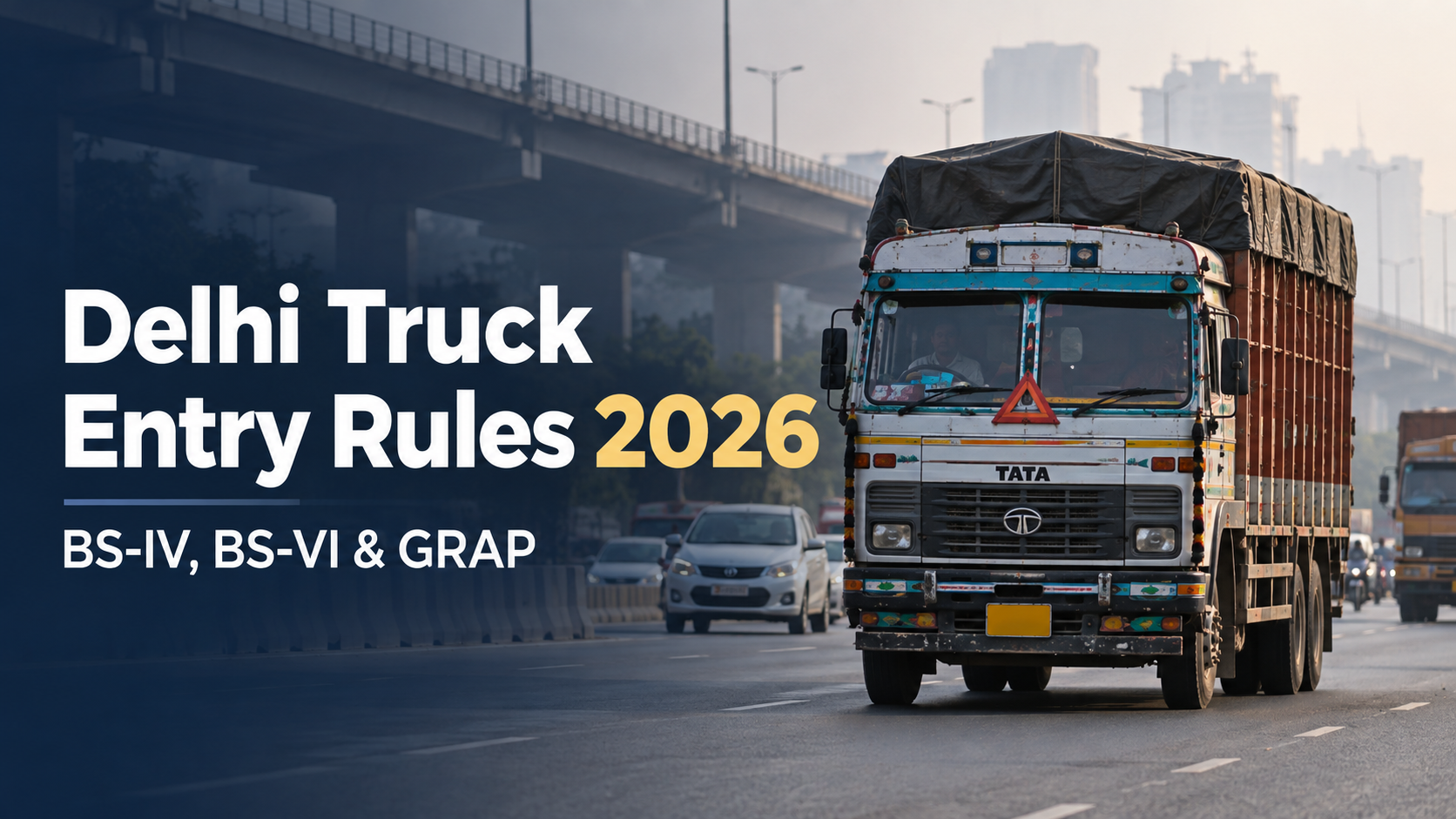
If you're planning to shift from Gurgaon, Noida, Ghaziabad or Faridabad into Delhi, the truck carrying your belongings now needs a little more attention than usual. From 1 November 2026, the general transition allowed to outside-Delhi BS-IV commercial goods vehicles ends under the CAQM's amended Direction No. 88.
So, a truck that looks perfectly fine for a house move may still face a problem at the Delhi border. What matters is where it is registered, which emission standard it follows and, in some cases, what fuel it runs on.
And no, the size of your home does not decide whether this rule applies to you or not. A 1BHK move can be affected too. The vehicle's registration, fuel type and emission standard do that job.
Pretty good answer needed?
For a Delhi-bound move on or after 1 November 2026, an outside-Delhi commercial goods vehicle will generally need to be BS-VI, CNG, LNG or electric to enter under CAQM Direction No. 88. Delhi-registered goods vehicles are treated as an exception under that direction, but they still have to follow GRAP, vehicle-age rules and any other restriction active at the time.
So ask for the truck's registration number and emission details before packing begins, not when the loaded vehicle is already heading towards Delhi.
So now the question is - what exactly changes on 1 November 2026?
CAQM amended Direction No. 88 on 17 October 2025. It covers light, medium and heavy commercial goods vehicles entering Delhi, and names BS-VI, CNG, LNG and electric vehicles as the main permitted categories. Vehicles registered in Delhi are an exception under this direction.
The amendment gave BS-IV commercial goods vehicles a transition period up to 31 October 2026. Once that ends, an outside-Delhi BS-IV truck should not be sent for a Delhi-bound move on the assumption that it will get entry. BS-III and older non-Delhi commercial goods vehicles have already been restricted since 1 November 2025.
One detail matters here: this is an entry rule for commercial goods vehicles coming into Delhi. It does not mean every BS-IV vehicle everywhere in Delhi suddenly becomes illegal. Registration, vehicle type and other active orders still matter.
Delhi's pollution-control plan can add seasonal entry measures too, so check CAQM's current GRAP orders alongside the direction before the truck is sent.
Okay, but which moving trucks can actually enter Delhi?
Here is the practical version for someone booking a house-shifting truck:
| Vehicle assigned to your move | Position from 1 November 2026 | What you should confirm |
|---|---|---|
| Outside-Delhi BS-VI goods vehicle | Generally permitted under Direction No. 88, subject to GRAP and other active rules | BS-VI status on the RC and the current GRAP stage |
| Outside-Delhi CNG, LNG or electric goods vehicle | Listed among the permitted categories, subject to other applicable restrictions | Fuel type, registration and whether any separate order applies |
| Outside-Delhi BS-IV goods vehicle | General transition ends on 31 October 2026; do not assume entry after that | Ask the mover to assign an eligible replacement before loading |
| Outside-Delhi BS-III or older goods vehicle | Already restricted from entering under the direction | Do not accept it for a Delhi-bound move |
| Delhi-registered goods vehicle | Excepted from this particular entry restriction | Vehicle age, GRAP conditions and other Delhi rules still need checking |
So in practical terms, a moving company should not assign an outside-Delhi BS-IV truck to enter the capital after that deadline and simply assume it will be allowed through. The safer approach is to confirm the exact vehicle first and keep an eligible alternative ready.
Will this Delhi Truck Entry Rules 2026 affect your route?
It may, especially if the pickup is outside Delhi and the destination is inside it. Crossing the border is what brings the entry rule into the picture.
1. Gurgaon to Delhi
A Gurgaon-to-Delhi truck enters from Haryana, so yes, the rule can apply. Check its registration, emission standard and fuel category before moving day.
2. Noida or Ghaziabad to Delhi
The same check applies to a Noida-to-Delhi move, or when the truck comes from Ghaziabad. The distance may be short, but a nearby pickup point does not create a separate exemption.
3. Faridabad to Delhi
Here too, the truck enters Delhi from Haryana. Its registration and emission details matter more than the number of cartons you're moving.
4. Another city to Delhi
Coming from Jaipur, Chandigarh, Dehradun or somewhere else? The truck will still cross into Delhi, so complete the same check before dispatch, even if the operator plans to change vehicles in NCR.
5. A move entirely within Delhi
Now, this is different. If both addresses are inside Delhi, the border-entry condition may not decide your move. But vehicle-age rules, GRAP measures and local traffic restrictions can still affect the truck. For the other things worth checking, such as building access and lift timings, check out our local shifting in Delhi guide.
BOXnMOVE follows the applicable rules and verifies the vehicle assigned to a Delhi-bound move before dispatch. It is a simple check, but doing it early can prevent a much bigger problem at the border.
The November rule and GRAP aren't the same thing
This part causes a lot of confusion, so let's separate the two.
The 1 November rule is a standing entry condition. GRAP, or the Graded Response Action Plan, is an emergency system that can be activated, tightened or withdrawn as Delhi-NCR's air quality changes.
So a truck may fit the regular entry rule and still face another restriction under GRAP. Under the current framework, Stage III can restrict certain outside-Delhi BS-IV diesel light commercial vehicles, apart from stated exceptions such as essential services. Stage IV can tighten truck entry further. Where GRAP is stricter, GRAP wins.
So don't rely only on what was true when you booked the move two weeks earlier. Ask the company to check the active GRAP stage again on the evening before dispatch or early on moving day.
Direct Comparison:
| Feature | The “November Rule” | GRAP (Graded Response Action Plan) |
|---|---|---|
| Nature | A judicial mandate / legal lock-in rule. | An emergency action plan / policy framework. |
| Enforced By | The Supreme Court of India. | The CAQM (Commission for Air Quality Management). |
| Trigger | Activated only when GRAP Stage 4 is reached. | Activated step-by-step based on real-time AQI forecasts. |
| Flexibility | Rigid. Locks Stage 4 restrictions in place until November ends. | Fluid. Designed to scale up or down based on changing air quality. |
What should you ask before booking the truck?
You don't need to turn the booking call into a vehicle inspection. Five questions are enough.
1. Where is the truck registered?
Ask for the state and, once assigned, the full registration number. Delhi and outside-Delhi vehicles are not treated in exactly the same way under Direction No. 88.
2. What is its emission standard?
Do not stop at “the truck is new.” Ask whether it is BS-VI, BS-IV or older, and check the Registration Certificate.
The government's Parivahan service may also show basic vehicle information. If the emission norm is unclear, ask the operator to show it in the vehicle documents before loading.
3. Which fuel does it use?
For an outside-Delhi vehicle, confirm whether it is diesel, CNG, LNG or electric. That small detail can decide whether it fits a permitted category.
4. What happens if that truck becomes ineligible?
Maybe GRAP becomes stricter, or the vehicle details don't match what you were told. Then the mover needs another option before packing starts. You definitely don't want to hear about the problem after your society's lift slot has already begun.
Also ask one small but important question: if the truck changes, will the timing or quotation change too? If BOXnMOVE needs to arrange another vehicle, its details can be confirmed with you before loading.
5. Will the GRAP status be checked again?
It should be. Restrictions can change closer to the date, so ask for one final check before dispatch.
Can this rule make your move costlier or slower?
Not automatically. With an eligible truck assigned from the beginning, the rule may not cause any separate problem. Trouble usually starts when the vehicle is checked at the last minute.
So where can the trouble actually begin? Usually, it is one of these situations:
- Your goods have been packed, but the assigned truck now has to be replaced.
- Everyone waits while the operator looks for another vehicle.
- A smaller compliant vehicle is arranged and the load needs an additional trip.
- The replacement arrives late and you miss the society's unloading slot.
- A stricter GRAP order leads to a timing change or rescheduling.
Before paying an advance, ask how a replacement, waiting time or extra trip would be handled. Any added charge should be explained and agreed first, not appear as a vague amount after delivery.
Your a day before check prior a Delhi-bound move
The evening before the move, take five minutes and run through this list:
- Get the registration number of the truck actually coming to your address.
- Match that number with the RC or available vehicle details.
- Confirm the emission standard and fuel type.
- Check whether CAQM or the Delhi Transport Department has issued a fresh order.
- Ask whether a GRAP stage is active and whether it affects the assigned truck.
- Reconfirm the loading time, Delhi arrival estimate and society unloading slot.
- Keep the replacement-vehicle plan clear before the first carton goes into the truck.
And remember, a booking receipt confirms the service, not the truck's eligibility. The registration and vehicle documents do that.
The simple takeaway
If your move enters Delhi on or after 1 November 2026, ask about the truck before you ask about the packing tape. For an outside-Delhi commercial goods vehicle, BS-VI, CNG, LNG and electric are the key categories named in the CAQM direction, while the broad BS-IV transition ends on 31 October 2026.
Then check once more for GRAP, because the rule active on moving day is the one that matters. It is a small check, yes, but it can save you from having a loaded truck waiting at the border while everyone at the new address waits too.
FAQs
1. Are all BS-IV trucks banned in Delhi from 1 November 2026?
No, that would be too broad. The direction deals with commercial goods vehicles entering Delhi and accepts Delhi-registered vehicles. The general transition for outside-Delhi BS-IV goods vehicles ends on 31 October 2026. Vehicle-age rules, GRAP and other orders still apply.
2. So which goods vehicles can actually enter Delhi from 1 November 2026?
A very short answer for this question: BS-VI, CNG, LNG and the electric commercial goods vehicles are the main categories which are named in the amended Direction No. 88, and with an exception for Delhi-registered vehicles. Still you'll need to check GRAP and also if any newer official order before dispatch has been issued or not.
3. Does this rule apply to a Gurgaon-to-Delhi house move also?
Yes, it can. The truck enters Delhi from Haryana, so an outside-Delhi vehicle's emission standard and fuel category should be checked before loading. A short route does not decide eligibility; the truck does.
4. What if the assigned truck is not eligible?
The mover should arrange an eligible vehicle or change the plan before loading. And do ask whether the replacement changes the arrival time, truck size or quotation. Settle that before your society slot begins.
5. Should the GRAP stage be checked again on moving day?
Yes. A stage can change close to your move. Ask the company to check the official status the previous evening and again before dispatch if air quality is worsening.
6. How exactly can I check whether my truck is BS-IV or BS-VI?
For that, check the Registration Certificate and try to match it to the assigned number. And yes. Parivahan may also show the basic details. If the emission category is unclear, then ask for a document rather than relying on a verbal answer.
7. So what happens if GRAP restrictions change on the same day of the move?
Again for this, first, the mover should compare the live order with your current assigned truck. If it is no longer eligible, the company will need to send a replacement, change the timing or reschedule. If the price changes too, get that confirmed before agreeing.